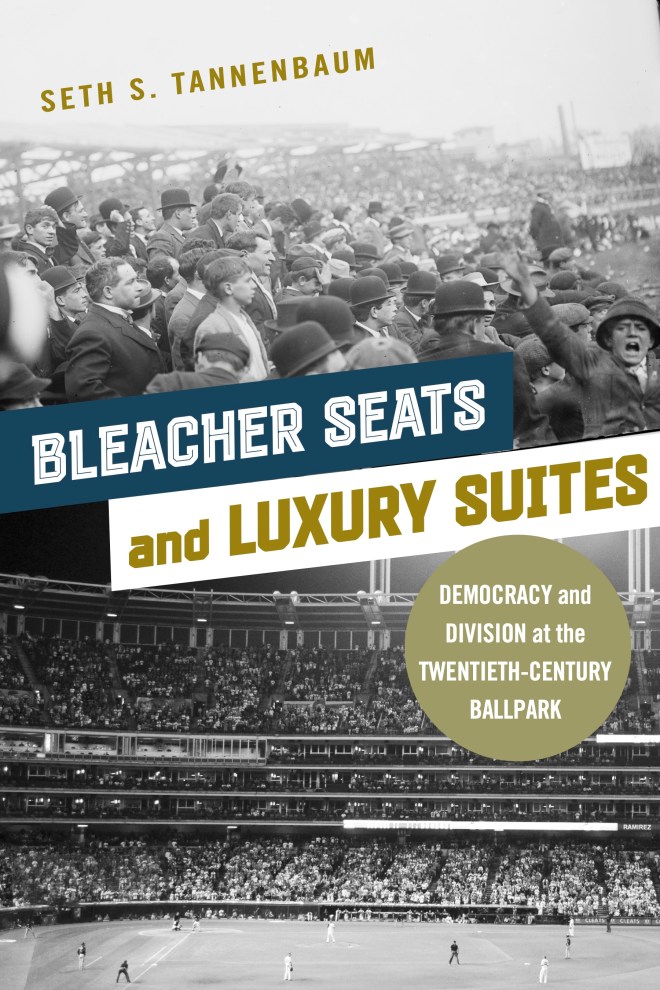
Bleacher Seats and Luxury Suites: Democracy and Division at the Twentieth-Century Ballpark is available through the University of Illinois Press website (promo code S26UIP saves 30% at checkout!), Bookshop.org, and Amazon.
For information on book events and author appearances, click here.
The book is a study of the fan experience at Major League Baseball games during the twentieth century and what this tells us about changing understandings of urban space, inclusion, and the American body politic. Bleacher Seats and Luxury Suites argues that baseball games were a purportedly inclusive space that were actually exclusive and divided, but that the exclusion and division was masked by rhetoric about the game that called it accessible to all and by the relative lack of explicit policies barring anyone. Instead, team owners built a system that was economically and socially stratified and increasingly physically removed from lower-class urban residents and people of color. Ballparks’ tiers allowed owners to give wealthier fans the option of sitting in the seats closest to home plate where they would not have to interact with poorer fans who owners pushed to the cheaper seats further from the action. That masked exclusion gave middle- and upper-class fans a space that was comfortable and safe because it was anything but truly accessible to all Americans. The book also argues that owners had to change the image of the ballpark and tinker with the exclusion there as fans’ tastes and their visions of what a city should look and feel like changed.
Throughout the twentieth century, newly-built ballparks relocated in response to how white middle- and upper-class Americans—the majority of fans in the park—felt about cities. At the beginning of the twentieth century, when urban centers were home to middle-class whites, ballparks were in cities. At mid-century, when middle-class whites moved out of cities and into the suburbs, ballparks moved to suburban-accessible locations. At the close of the twentieth century, when middle-class white people again found cities attractive—provided they were comfortable and safe—ballparks moved back to urban locations, albeit ones that could be carefully controlled and regulated to guarantee fans would be entertained. Each chapter in Bleacher Seats and Luxury Suites uses a different ballpark as a window onto the broader experience and American society. The ballparks—the Polo Grounds, Yankee Stadium, Dodger Stadium, the Astrodome, and Camden Yards—are simultaneously representative of the fan experience in their eras and important to understanding changes in that experience.
_____________________________________________
Two of the best scholars of the place of baseball and stadiums have lovely things to say about Bleacher Seats and Luxury Suites, see below:
- “Seth Tannenbaum’s Bleacher Seats and Luxury Suites arrives right on time. At a moment when sports franchise owners and politicians continue to tout the public benefits of stadium construction, Tannenbaum offers a useful history of the longstanding exclusionary dynamics embedded in the fan experience. This is an important book that should be read by scholars and fans alike.” — Frank Andre Guridy, author of The Stadium: An American History of Politics, Protest, and Play
- “Tannenbaum‘s insightful analysis opens our eyes to the choices MLB front offices made that shaped the location of big league ballparks, produced stadium designs that influenced where fans from different class or racial backgrounds entered and sat, the degree to which women were welcomed as fans, and the changing food options that constituted a key part of the ballpark experience. These choices combined to privilege an idealized fan who was ultimately white, male, suburban and middle class.” — Adrian Burgos, Jr., author of Cuban Star: How One Negro League Owner Changed the Face of Baseball
 Seth S. Tannenbaum, Ph.D.